 English (UK)

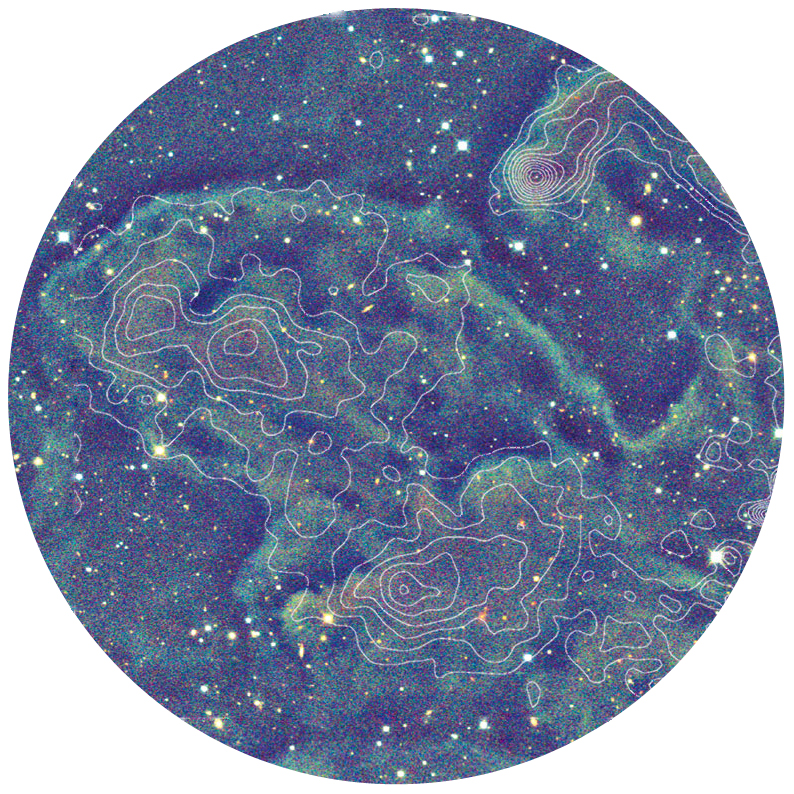
The dark clouds of gas and dust that populate the space among the stars are not as dark as previosuly beleived. A recent study done at infrared wavelengths at Calar Alto Observatory, shows that some of these clouds do shine, and display beautiful extended emission most likely due to scattered ambient starlight. The authors of this study named this new light cloudshine...
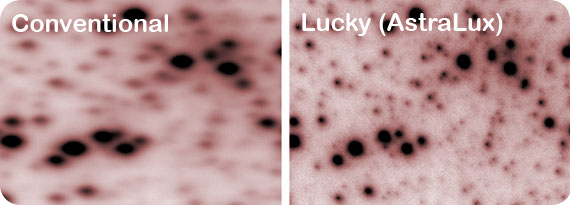
AstraLux, a new, simple instrument developed at the Max Planck Institute for Astronomy in Heidelberg, has demonstrated at Calar Alto its ability to register extremely sharp astronomical images, comparable in resolution to views obtained with the Hubble Space Telescope...
 Calar
Alto participates in a multi-observatory effort to study the most
luminous quasar ever observed. The object, radio quasar 3C 454.3 in the
constellation Pegasus, experienced during 2005 a strong optical
outburst that made it observable even with amateur instrumentation (reaching R = 12 mag). According to the WEBT team, "this ourburst peak likely represents the most luminous quasar state
ever observed". The same team quantified the maximum luminosity of this
object as MB = -31.4 mag. This means that, at its maximum and when
observed in blue light, 3C 454.3 was as bright as 550 billions of suns
put together...
Calar
Alto participates in a multi-observatory effort to study the most
luminous quasar ever observed. The object, radio quasar 3C 454.3 in the
constellation Pegasus, experienced during 2005 a strong optical
outburst that made it observable even with amateur instrumentation (reaching R = 12 mag). According to the WEBT team, "this ourburst peak likely represents the most luminous quasar state
ever observed". The same team quantified the maximum luminosity of this
object as MB = -31.4 mag. This means that, at its maximum and when
observed in blue light, 3C 454.3 was as bright as 550 billions of suns
put together...
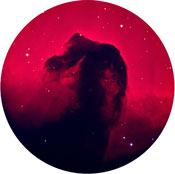 The famous HorseHead Nebula in Orion (also known as Barnard 33) as seen from Calar Alto. This unusual shaped nebula was first spotted in 1888 on a photographic plate taken at the Harvard College Observatory. The nebula is located just below
Alnitak, the easternmost star of Orion's Belt, lies at a distance of
about 1500 light-years from Earth, and is approximately 3.5 light-years
wide. The red glow originates from hydrogen gas predominantly behind
the nebula, ionized by the nearby bright star Sigma Orionis. The
darkness of the Horsehead is caused by tiny...
The famous HorseHead Nebula in Orion (also known as Barnard 33) as seen from Calar Alto. This unusual shaped nebula was first spotted in 1888 on a photographic plate taken at the Harvard College Observatory. The nebula is located just below
Alnitak, the easternmost star of Orion's Belt, lies at a distance of
about 1500 light-years from Earth, and is approximately 3.5 light-years
wide. The red glow originates from hydrogen gas predominantly behind
the nebula, ionized by the nearby bright star Sigma Orionis. The
darkness of the Horsehead is caused by tiny...
Page 50 of 50